
Drinks
Homemade beer: easy blonde ale for beginners
Brew a golden ale with dry malt extract and Cascade hops. Start with 10 litres of wort and learn to manage fermentation and bottle conditioning.
- Total time
- 30 days 3 hr
- Preparation
- 1 hr 50 min
- Cooking
- 1 hr 10 min
- Rest / waiting
- 30 days
- Servings
- 30
- Difficulty
- Medium
- Cuisine
- International
Ingredients
Method
Clean and sanitise the equipment
Gather a pot of at least 15 L, food-safe fermenter of at least 15 L with an airlock, thermometer, hydrometer and trial jar, scales, siphon, bottling bucket, filler, capper and intact pressure-rated beer bottles. Wash first, then sanitise every surface that will contact cooled wort using the brewing sanitiser’s dilution and contact time. Do not rinse a no-rinse product. Keep some boiled, cooled water covered for topping up.
Dissolve the malt extract
Heat 11.5 L of chlorine-free water. Take the pot off the heat and stir in 1200 g of pale dry malt extract until fully dissolved with no powder on the bottom. Use unhopped extract; milled malt is not a direct replacement in this recipe. Leave plenty of headspace for foaming.
Boil and add the hops
Bring the uncovered wort to a rolling boil and start a 60-minute timer. Add 10 g of Cascade immediately, then the remaining 10 g with 10 minutes left. Watch the foam and adjust the heat to avoid a boil-over. Bitterness depends on the alpha acids on your hop packet. Do not add the priming sugar yet.
Chill and adjust the volume
Cool the pot in an external ice-water bath or with a sanitised immersion chiller to 18–20 °C (64–68 °F). Keep bath water out of the wort. Transfer into the sanitised fermenter, leaving most sediment behind. Only if needed, top up to 10 L with reserved boiled, cooled water. Record the original gravity at your hydrometer’s calibration temperature; approximately 1.044–1.048 is expected. Never return the sample to the batch.
Pitch the yeast and ferment
Aerate the cooled wort by agitation before adding yeast. Sprinkle in 6 g of US-05 at 18–20 °C (64–68 °F). Fit the lid and a correctly filled airlock that lets CO₂ escape; never seal a fermenter without a gas outlet. Keep the beer itself at 18–20 °C, protected from light, for roughly 14–21 days. Monitor liquid temperature rather than room temperature alone; avoid opening or shaking during fermentation.
Confirm completion and prepare priming sugar
Before bottling, obtain identical gravity readings at least 72 hours apart that also match the expected finish, around 1.008–1.012. Stable but high gravity may mean stalled fermentation: investigate instead of bottling. Airlock bubbles alone are not proof. Measure the actual volume going into bottles. For beer fermented at 18–20 °C, use 5 g of sucrose per litre: 45 g for 9 L. Boil with 100 ml of reserved water for 10 minutes, then cool covered. Recalculate with a priming calculator if temperature, sugar type or carbonation target changes.
Bottle and allow to carbonate
Put the syrup in the sanitised bottling bucket and siphon the beer onto it without splashing or disturbing the sediment. Stir gently with a sanitised utensil to distribute the sugar evenly. Fill intact pressure-rated beer bottles with 2–3 cm headspace and fit new sanitised crown caps. Never use wine bottles, decorative bottles or damaged glass. Keep upright, dark and at 18–20 °C (64–68 °F) for 14–21 days, or longer if needed. Chill one bottle for 48 hours before testing carbonation.
Chill and serve the blonde ale
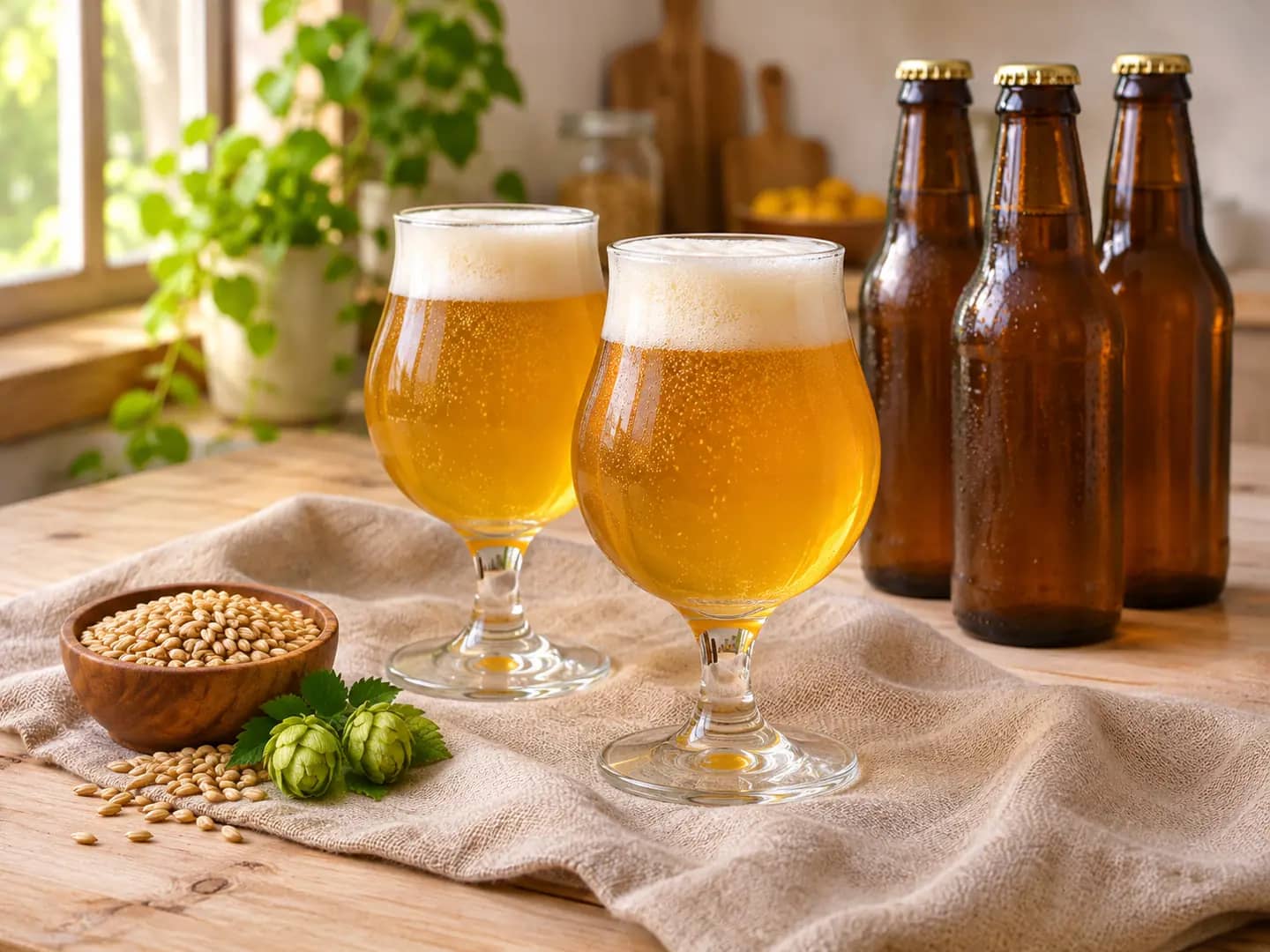
Once carbonation is satisfactory, store cold. Serve around 6–8 °C (43–46 °F), tilting the glass and leaving the last yeast sediment in the bottle. Approximate yield is 9 L, or 30 glasses of 300 ml. Expected alcohol is around 4.5–5.5% ABV, depending on the batch: estimate (original gravity − final gravity) × 131.25 before the small increase from priming; this is not laboratory measurement. Alcoholic drink for adults only.
The step photos are illustrative.
Notes
Equipment and tips
Provide cooling or a controlled location if room temperature exceeds 20 °C; do not ferment this formulation at 30–36 °C. Sanitising does not replace washing. Never start a siphon by mouth. Use a hydrometer to judge when to bottle. The displayed total uses an indicative minimum of 30 days waiting plus 3 hours; it may take longer.
Substitutions
Do not swap dry extract for liquid extract, grain or sugar at the same weight. Different yeast needs its own temperature range. Adjust bitterness when changing hops. Adding more sugar will not safely speed up carbonation.
Storage and precautions
Refrigerate once carbonated; aim to drink within 2–3 months for quality, not as a validated shelf life. Do not taste mouldy batches or handle damaged or abnormally pressurised bottles. Contains barley and gluten. This is not alcohol-free beer and brief boiling cannot make it reliably alcohol-free. Adults only; avoid during pregnancy and before driving.
Sources
Nutrition facts
1 glass, 300 ml
- Protein
- 1.4 g
- Carbohydrates
- 10.7 g
- Fat
- 0 g
Reference estimate for finished beer, not analysis of this batch: USDA 168746 regular beer multiplied by 3 for 300 ml, assuming 1 g/ml. Includes alcohol energy. Raw ingredients are not summed because fermentation changes their sugars; actual alcohol and residual extract may change the values.
Reference source: USDA FoodData Central, SR Legacy; Alcoholic beverage, beer, regular, all; FDC 168746
For general information only; it does not replace advice from a qualified health or nutrition professional.
About this recipe
Dry malt extract makes this homebrewed beer accessible without a grain mash, leaving you to focus on cleaning, boiling and fermentation. Start with 10 litres in the fermenter and expect roughly 9 litres bottled after sediment and sampling losses. The intended result is a golden blonde ale with moderate bitterness and a gentle citrus hop character. Allow about 30–44 days plus 3 hours of work split between brewing and bottling.
Frequently asked questions
How long does homemade beer take?
About 30–44 days plus 3 hours of work: 14–21 days fermenting, 14–21 days carbonating and 2 days chilling. Measurements take priority; incomplete fermentation or carbonation needs more time.
Can I bottle without a hydrometer?
It is not advisable for this recipe. Airlock activity can stop before fermentation finishes, leaving fermentable sugar that can create excessive bottle pressure.
How much sugar goes in each bottle?
Calculate for the entire measured volume and mix evenly: 5 g of sucrose per litre under the stated conditions. That means 45 g for 9 L, never 45 g per bottle.
Can I make this alcohol-free?
Fermentation creates alcohol. Leaving out priming sugar does not make the beer alcohol-free; that requires another process and verification of residual alcohol.