
Desserts
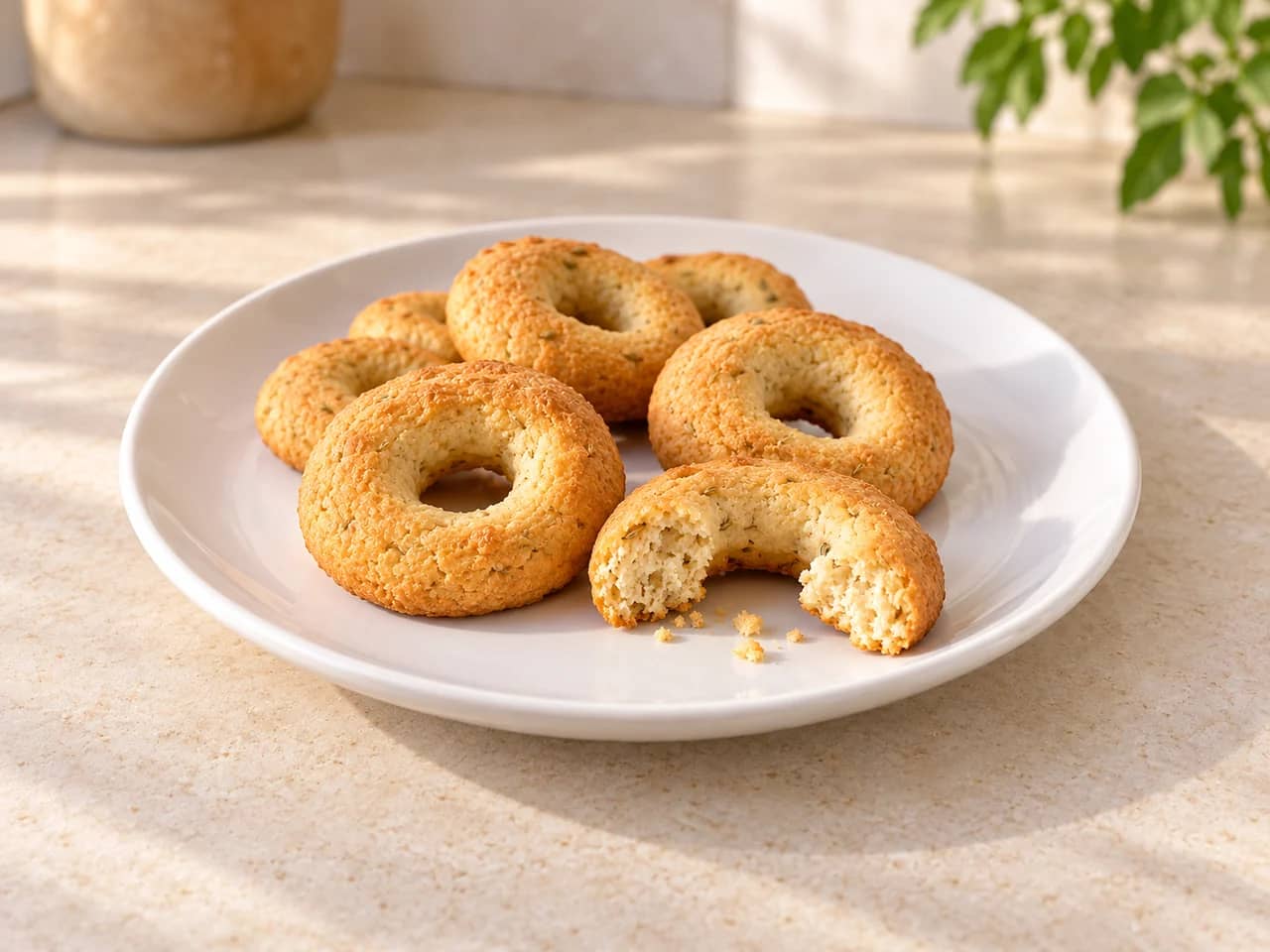
Baked green anise biscuit rings with orange
Small anise biscuit rings with orange and olive oil: grouped quantities, resting, two oven batches and full cooling, with estimated USDA nutrition and missing data stated.
- Total time
- 105 min
- Servings
- 18
- Difficulty
- Easy
- Cuisine
- Spanish inspired
Ingredients
Dough
Flavor and raising agent
Method
Prepare the ingredients and trays
Set out scales, bowls, a mortar, spatula, knife and two trays about 30 × 40 cm lined with baking parchment, without extra grease. Wash the orange under running water before cutting and squeeze it; remove seeds and weigh 100 g juice. Separately weigh 300 g flour, 80 g oil, 70 g sugar, 4 g green anise seeds, 6 g baking powder and 1 g salt. Use food-grade green anise seeds, not star anise, fennel or liqueur.
Crush the anise and combine dry ingredients
Briefly crush the 4 g anise in the mortar to break the seeds without discarding any part. Use a spoon to distribute the 300 g flour, 6 g baking powder and 1 g salt evenly in a bowl. This version uses a chemical raising agent rather than baker's yeast. Do not taste raw flour or dough even though there is no egg.
Mix the juice, oil and sugar
In another bowl, combine 100 g orange juice, 80 g oil and 70 g sugar. Whisk to disperse the sugar and add all the crushed anise. Some sugar may remain undissolved and the oil may separate when you stop: stir again before combining. Do not add egg, milk, liqueur or a topping.
Bring the dough together and rest it
Add the liquids to the dry ingredients and mix with a spatula until no loose flour remains. Bring together with clean hands without kneading like bread or flouring the worktop. Cover and rest for 10 minutes to hydrate the flour. The dough should roll into a cord without crumbling; if the amounts do not achieve this, adjust the water or flour little by little. Set the oven to 180 °C, conventional top and bottom heat, to preheat for about 15 minutes while shaping.
Shape small rings
Divide all the dough into 18 portions as evenly as possible, about 31 g raw dough each; the total of 561 g ingredients. Roll each portion on a clean unfloured surface into a cord about 16 cm long and press its ends together. Make rings about 6 cm across externally with an open hole. Arrange 9 on each tray in three rows, about 3 cm apart; do not dust with sugar.
Bake in batches and check the centers
Bake the first tray on the middle level at 180 °C for about 18 minutes, until the rings are firm, lightly golden underneath and not wet inside when one is opened. Remove and allow about 4 minutes for the oven to recover its temperature before baking the second tray for another 18 minutes. Allow 40 minutes for both batches. If the center remains wet dough, extend baking; do not judge only by color or taste raw dough.
Cool completely on a rack
Leave each batch on its tray for about 5 minutes, then transfer to a wire rack with a spatula. Allow about 30 minutes total cooling per batch, including those 5; the first cools while the second bakes, so count only the final cooling after the last batch separately. Cool fully before sealing a container: these should be small biscuit-textured rings, not fluffy bread, without icing or added decoration.
Serve and store the cooled rings
The yield is 18 rings; one piece is the serving used for estimated nutrition. The full plan totals 105 minutes: 25 active preparation, 10 resting, 40 baking in batches and 30 final cooling; preheating happens during shaping. To store, keep completely cool in an airtight container somewhere cool and dry for up to 3 days; discard without tasting if dampness or mold develops.
The step photos are illustrative.
Notes
Nutrition facts
One of the 18 pieces
- Protein
- 1.8 g
- Carbohydrates
- 17.4 g
- Fat
- 4.7 g
- Saturated fat
- 0.6 g
- Fiber
- 0.5 g
- Sodium
- 48 mg
Nutrition information estimated from the ingredients (USDA FoodData Central). Brands may vary.
Reference source: USDA FoodData Central — SR Legacy
For general information only; it does not replace advice from a qualified health or nutrition professional.
About this recipe
Small baked biscuit rings made with green anise seeds, olive oil and orange juice. An original formula for 18 pieces, with no added liqueur, egg or milk.
Frequently asked questions
Are these rings bread or fried doughnuts?
They are small baked rings with biscuit texture and a chemical raising agent. No baker's yeast, frying, liqueur or icing.
Can star anise or liqueur replace green anise?
They are neither bread nor fried doughnuts. Use 4 g food-grade green anise seeds and retain all the crushed seed. Other spices, liqueurs and extracts change flavor, composition and hydration and require a different formula and calculation.
Why is total sugar missing, and how long do they keep?
The USDA anise record does not report sugar; neither zero nor an incomplete sum is invented as a total. The seven available nutrients are estimated for one of the 18 pieces. They keep for up to 3 days fully cool, airtight, cool and dry; humidity and climate can shorten that time.