
Desserts
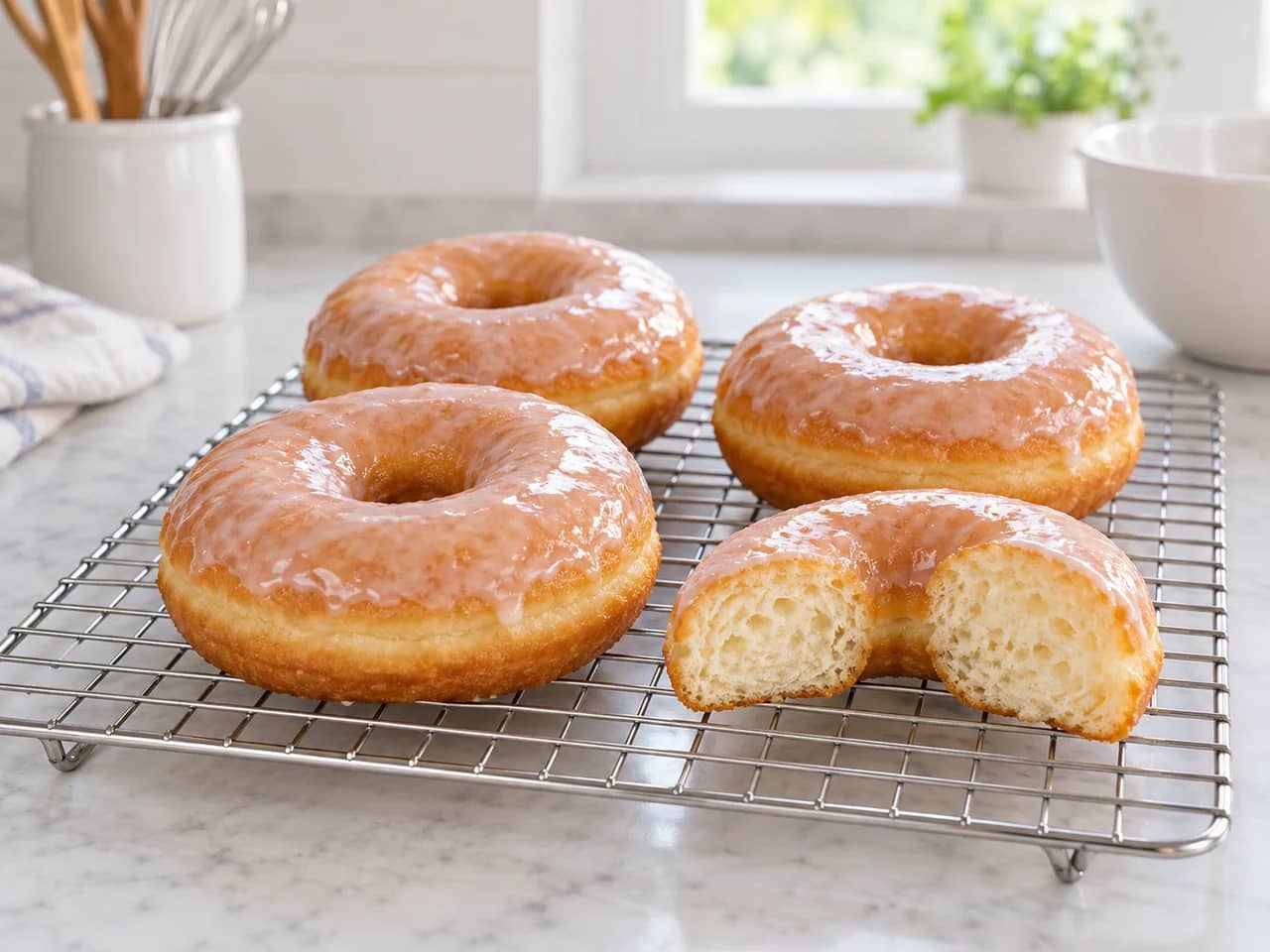
Vanilla-glazed yeast doughnuts
Homemade ring doughnuts with two rises, small-batch frying and vanilla glaze.
- Total time
- 198 min
- Servings
- 12
- Difficulty
- Medium
- Cuisine
- Home cooking
Ingredients
Dough
Shaping and frying
Glaze
Method
Soften the butter and organize the frying area
Dice the 30 g butter and leave it at room temperature for about 20 minutes until soft but not melted; allow longer if still firm. Set out scales, a bowl, spatula, tray, cooling rack, dry skimmer and frying thermometer. Use a stable, tall-sided pot about 20 cm in diameter and keep its metal lid nearby. Weigh every ingredient, including the egg without its shell. Separate the 300 g dough flour from the 10 g for the work surface. Keep egg and milk refrigerated until needed.
Hydrate the yeast and mix the dough
Warm the 150 g milk to around 30 °C, never above 40 °C. Mix in the 5 g active dry baker's yeast and hydrate for 5 minutes; also follow the manufacturer's instructions. In the bowl, combine the 300 g flour, 40 g sugar and 3 g salt. Add milk and yeast with the 50 g shelled egg. Stir into a dough without tasting it raw. Baking powder and baker's yeast are not interchangeable.
Knead in the butter
Knead to combine, then work in the 30 g soft butter in small portions. Continue kneading for about 8–10 minutes until elastic and smoother, although still slightly sticky. Scrape the work surface with the spatula as needed; do not add extra flour to dry the dough. Shape a ball and place in the clean bowl. Wash hands and surfaces after handling raw egg and flour.
Let the dough rise
Cover the bowl and rise in a warm place around 24–26 °C for roughly 60 minutes as a reference. Look for clearly aerated dough close to double its volume; the clock cannot replace this sign. If still compact, extend to about 90 minutes or as needed and add that time to the total. Avoid direct heat, a switched-on oven or strong sunlight.
Shape twelve rings without scraps
Turn the dough onto the work surface lightly dusted with the reserved 10 g flour. Gently deflate and divide all the dough into 12 equal portions of about 48 g; the dough totals 578 g before the dusting flour. Round each portion, poke the center with a clean finger and gently stretch into a ring about 7 cm across with a 3 cm hole. Do not cut circles or produce leftover dough balls. Space the rings on a tray dusted with some of that same measured flour.
Proof the rings and heat the oil
Cover the rings without pressing them and let them puff for about 30 minutes; allow roughly 30–45 depending on temperature and check that they look light. During the last 15 minutes, heat the 900 g oil in the pot to 175 °C, checking with a thermometer. Fill no more than one third of the pot; use a more suitable pot if that quantity exceeds the limit. Heating overlaps this rise. Never leave oil unattended or add water; if it smokes, switch off the heat and let the temperature fall.
Fry in pairs and check the crumb
Carefully lower two rings at a time without dropping or crowding them. Keep the oil near 175 °C and fry for about 90 seconds per side as a starting point, turning with the dry skimmer until both sides are golden. Lift onto the rack and check the first doughnut with a small cut once safe to handle: the crumb should be cooked with no band of raw dough. If underdone, adjust the time for that batch and the following ones. Fry the 12 rings in six reference batches of 3 minutes: 18 minutes frying plus about 5 for temperature recovery, a total of 23. Never cover the pot during normal frying.
Drain and cool before glazing
Leave the doughnuts on the rack over a catching tray for about 15 minutes after the final batch, until cool or barely warm. The earlier doughnuts cool while later batches fry. Do not stack them or dip them hot into glaze. Switch off the heat and leave oil in its pot until completely cold before handling or disposing of it.
Mix and apply the glaze
Sift the 200 g powdered sugar into a clean bowl and mix with the 30 g drinking water and 3 g vanilla until smooth and flowing in a ribbon. Mixing and dipping take about 5 minutes of the planned preparation. Dip only the top of each cool doughnut, lift and let excess drip back into the same bowl; return to the rack. Add no second coating or decoration. Glaze left in the bowl has not been measured or shown to have been consumed.
Let the glaze set and serve
Let the glaze set for about 15 minutes before serving a doughnut per portion. That is 12 doughnuts and 198 minutes: 20 softening +35 preparation, including glaze mixing and 5 yeast hydration +60 first rise +30 second rise +23 frying and temperature recovery +15 final cooling +15 setting. Slower rises or extra batches extend the total.
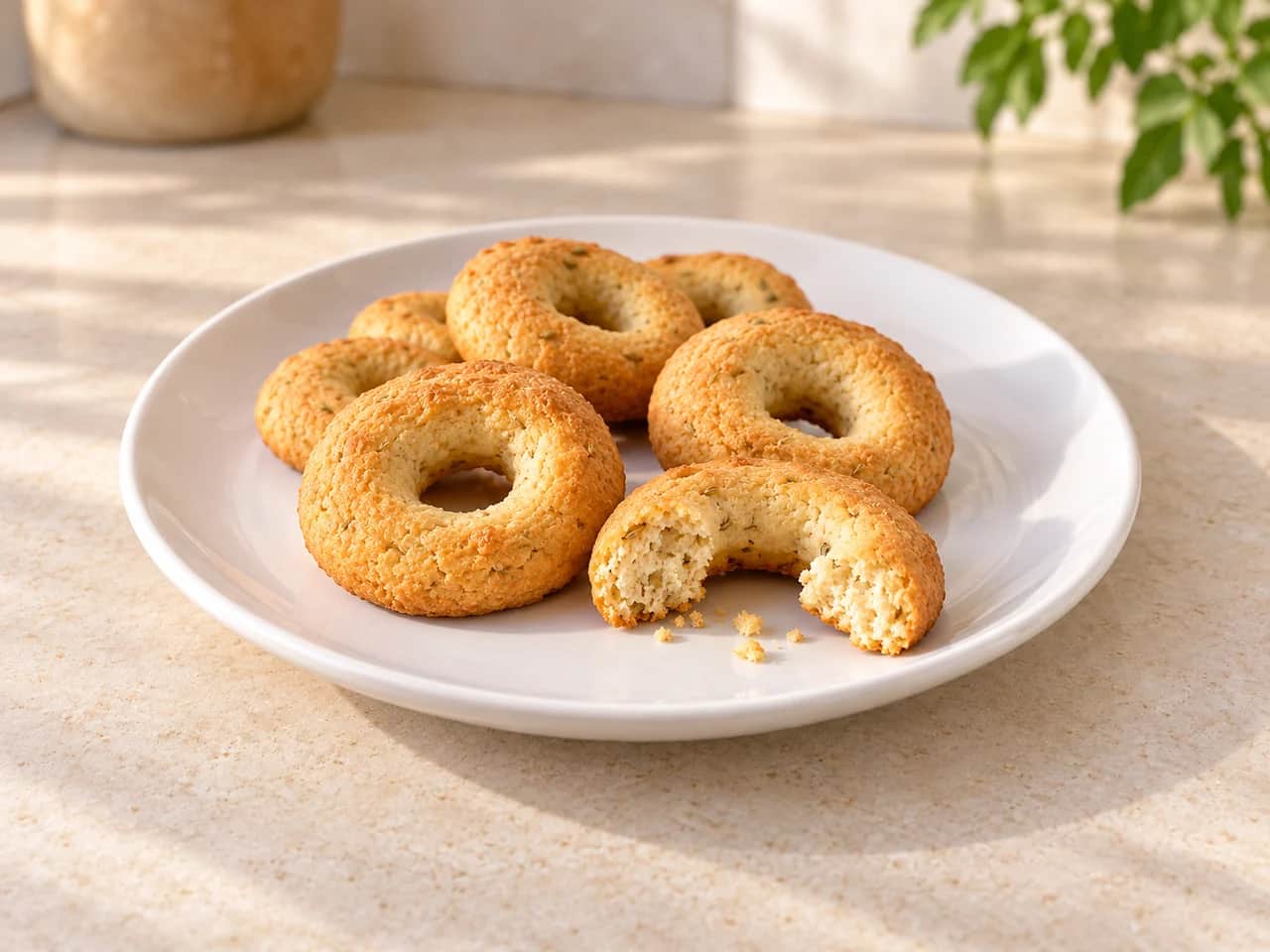
The step photos are illustrative.
Notes
Nutrition facts
One of twelve equal doughnuts
- Protein
- 3.8 g
- Carbohydrates
- 40.5 g
- Fat
- 5.6 g
- Saturated fat
- 1.9 g
- Fiber
- 0.8 g
- Sugars
- 20.4 g
- Sodium
- 110 mg
Nutrition information estimated from the ingredients (USDA FoodData Central). Brands may vary.
Reference source: USDA FoodData Central — SR Legacy
For general information only; it does not replace advice from a qualified health or nutrition professional.
About this recipe
Yeast ring doughnuts with two rises, frying in pairs and a simple vanilla glaze on top. It makes 12 doughnuts in 198 minutes overall.
Frequently asked questions
Which yeast do I need, and when is the dough ready?
Use 5 g active dry baker's yeast, not baking powder. The first rise has a 60-minute reference but may take 90 or longer; look for airy dough close to double its volume. The second rise needs about 30–45 minutes and puffy rings.
How do I avoid a golden outside and raw center?
Keep oil around 175 °C and fry two rings per batch, about 90 seconds per side as a starting point. Make a small cut into the first doughnut and adjust if raw dough remains. Color, time and size vary with equipment.
How much oil is included, and how should I store them?
All flour and glaze are also counted despite possible leftovers. It makes 12 doughnuts; preferably eat the same day, and keep at most 1 day in a cool dry place. Refrigerate at 4 °C or below in warm or humid conditions.