
Desserts
Oatmeal and dark chocolate cookies
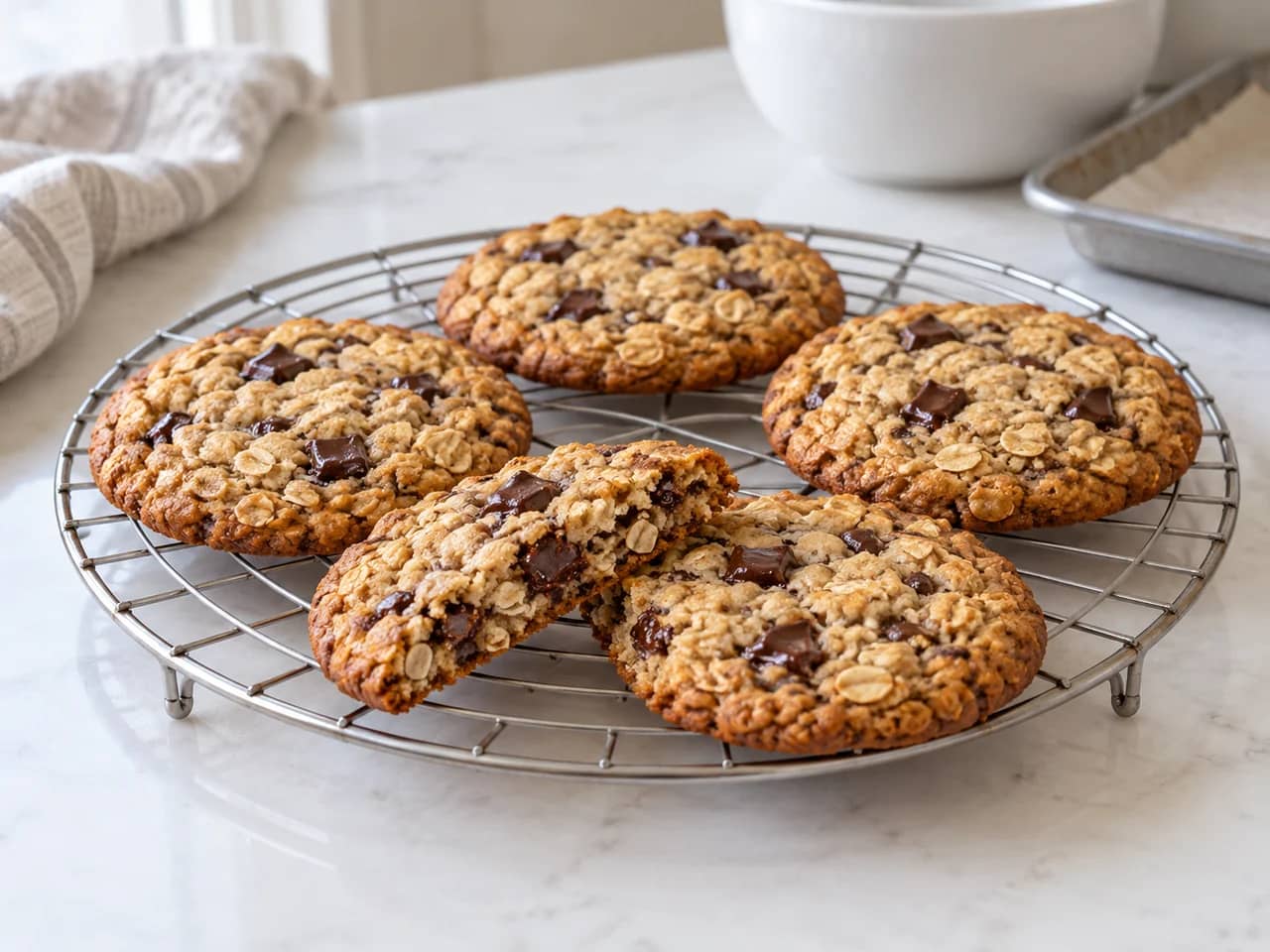
Homemade oat and chocolate cookies with weighed ingredients, chilled dough, two baking batches and estimated nutrition per cookie.
- Total time
- 118 min
- Servings
- 20
- Difficulty
- Easy
- Cuisine
- Home cooking
Ingredients
Dry ingredients and chocolate
Creamed mixture
Dry ingredients and chocolate
Method
Soften the butter and prepare the equipment
Dice the 100 g unsalted butter and leave it at room temperature for about 20 minutes until it yields to pressure without melting; allow longer if it stays hard. Prepare scales, two bowls, a spatula, a beater and two metal baking trays roughly 40 ×30 cm lined with baking parchment. Weigh the remaining ingredients; the 50 g egg is weighed without its shell and does not necessarily equal one whole egg. Keep the egg chilled until adding it.
Cream the butter with both sugars
Beat the soft butter with the 100 g brown sugar and the 40 g white sugar for about 2 minutes until uniformly creamy. Scrape the bottom and sides so no butter cubes remain. Do not melt the butter or try to dissolve every sugar crystal; a slightly grainy texture is fine.
Add the egg and vanilla
Add the 50 g shell-free egg and the 4 g vanilla extract. Beat for approximately 1 minute until combined, scraping the bowl again. If the mixture looks slightly separated, continue with the dry ingredients in the next step. Wash hands and equipment that touched raw egg; do not taste this mixture.
Mix and incorporate the flour
In the second bowl, mix the 120 g flour, the 4 g baking powder and the 1 g salt evenly. Add these dry ingredients to the creamed mixture and stir with a spatula just until no flour remains visible. Do not use self-rising flour or beat for a long time: the dough should be thick with no pockets of powder.
Fold in the oats and chocolate
Add the 150 g rolled oats and the 100 g chopped chocolate. Fold up from the bottom with the spatula to distribute them; keep the oats in whole flakes rather than grinding them. The dough is firm and sticky. Do not add milk or water, and do not taste the raw dough because it contains uncooked flour and egg.
Chill the dough and preheat the oven
Cover the bowl and refrigerate the dough for 30 minutes at 4 °C or below to firm it up. During the final 15 minutes of chilling, preheat the oven to 180 °C conventional heat with a middle rack. Preheating overlaps chilling and is not added again to the total time. Keep the second batch refrigerated while the first one bakes.
Shape twenty equal portions
Divide all the dough into 20 equal portions of about 33–34 g; the ingredients total 669 g before cooking. Form balls and gently flatten into discs about 4 cm across and 1 cm thick. Put 10 on each cold tray, leaving about 5 cm between their edges. If this arrangement does not fit your tray, use more batches and extend the total time.
Bake one tray at a time
Bake the first tray on the middle rack at 180 °C for 14 minutes as a reference; start checking at 12 and expect about 12–16 depending on the oven. The edges should be golden and the centers set, without shiny wet raw dough; slightly flexible centers firm as they cool. If more cooking is needed, add 2 minutes and check again. Remove with dry oven gloves and bake the second tray the same way. The two reference batches total 28 minutes in the oven.
Cool on a rack and store only when cold
Leave each batch on its tray for 5 minutes, then use a spatula to transfer it to a rack for about 15 more minutes. The first batch cools while the second one bakes; count 20 minutes after the last batch. The proposed total is 118 minutes: 20 for butter softening +20 active preparation +30 chilling +28 baking +20 final cooling. Serve one cookie per portion, with a proposed yield of 20 and no measured finished weight.
The step photos are illustrative.
Notes
Nutrition facts
One of twenty equal proposed cookies; no measured finished weight
- Protein
- 2.3 g
- Carbohydrates
- 19.3 g
- Fat
- 6.8 g
- Saturated fat
- 3.8 g
- Fiber
- 1.3 g
- Sugars
- 8.8 g
- Sodium
- 42 mg
Ingredient-based estimate, not an analysis or kitchen trial. Regular unfortified dry oats model rolled oats; enriched unbleached white flour models plain flour. Chocolate with 60–69 % cacao and double-acting baking powder can vary by brand, especially sugar and sodium. Adjust to the actual yield if it differs. All eight nutrients are present in all ten records; missing values are never filled with zero.
Reference source: USDA FoodData Central — SR Legacy
For general information only; it does not replace advice from a qualified health or nutrition professional.
About this recipe
Cookies with whole rolled oats and dark chocolate chunks, made from creamed butter and chilled dough. The proposed yield is 20 cookies in 118 minutes including butter softening, two baking batches and cooling; the formula and yield await kitchen testing.
Frequently asked questions
Which oats and chocolate should I use?
Use 150 g plain rolled oats, not sweetened instant oats, and 100 g dark chocolate with 60–69 % cacao. Keep the flakes whole. Another chocolate percentage or prepared cereal mix changes the formula and nutrition.
Why must I chill the dough?
The 30 minutes at 4 °C or below help firm the butter and make shaping 20 equal discs easier. Do not skip chilling or use melted butter. Keep the second tray chilled and never taste raw dough.
How long do they take and how should I store them?
The proposed total is 118 minutes: 20 softening, 20 preparation, 30 chilling, 28 baking in two batches and 20 final cooling. Start checking each batch at 12 minutes at 180 °C. Store completely cold and eat within 3 days as an untested suggestion; in heat or humidity refrigerate at 4 °C or below.