
Main dishes
Pan-Seared Filet Mignon with Garlic Thyme Butter
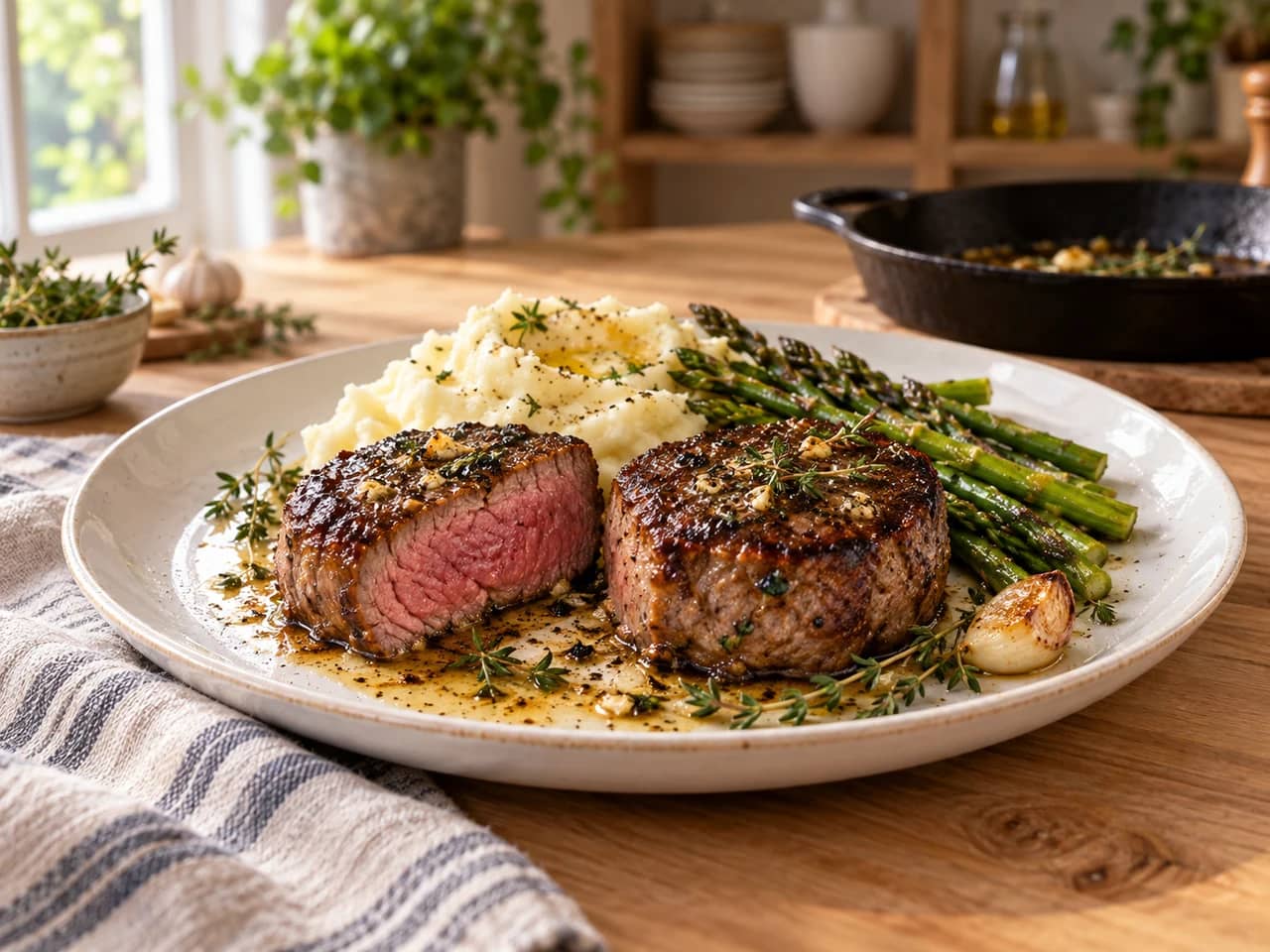
Juicy filet mignon with a dark golden crust, seared in cast iron, basted with garlic and thyme butter and finished in the oven. About 15 minutes of cooking.
- Total time
- 50 min
- Servings
- 2
- Difficulty
- Medium
- Cuisine
- International
Ingredients
For the steaks
For basting
Method
Temper and dry the meat
Take the steaks out of the fridge 30 minutes ahead, pat them very dry with paper towels and preheat the oven to 400 °F (200 °C).
Season
Season the steaks with the salt and pepper on every side, including the edges.
Heat the skillet
Heat an oven-safe cast-iron skillet over high heat for 4 to 5 minutes and add the oil.
Sear the steaks
Add the steaks and sear for 2 to 3 minutes per side without moving them, until a dark golden crust forms.
Baste with butter
Lower the heat to medium, add the butter, garlic, thyme and rosemary, tilt the pan and spoon the butter over the steaks for 1 minute.
Finish in the oven
Move the skillet to the oven for 4 to 6 minutes and pull the steaks at 125 °F (52 °C) for medium-rare or 140 °F (60 °C) for medium.
Let them rest
Transfer the steaks to a board, spoon a little of the pan butter over them and rest for 5 minutes.
Serve
Serve the steaks whole or halved, drizzled with the garlic butter, with mashed potatoes and asparagus.
The step photos are illustrative.
Notes
Tips
- Choose steaks of the same thickness (about 1 1/2 inches) so they cook evenly.
- Dry the meat very well: surface moisture prevents a good crust.
- Do not move the steaks while they sear; they release on their own once the crust has formed.
- Use a thermometer: the temperature rises 3 to 5 °F while resting. The USDA recommends cooking whole cuts of beef to 145 °F (63 °C) with a 3-minute rest.
- Tie each steak around the edge with kitchen twine if you want it to keep a neat round shape.
Substitutions
- Cut: pork tenderloin or beef ribeye, adjusting the time to the thickness.
- Herbs: thyme only, or sage instead of rosemary.
- Fat: clarified butter or ghee for a cleaner flavor.
- No cast iron: a heavy oven-safe stainless steel skillet.
Storage
Refrigerate leftover steak in a covered container within 2 hours and eat within 3 to 4 days. Reheat gently, or slice it thin and cold for salads or sandwiches.
Sources: USDA FSIS, safe minimum internal temperatures; USDA FSIS, leftovers and food safety.
Nutrition facts
1 steak (1/2 of the recipe)
- Protein
- 41.8 g
- Carbohydrates
- 1 g
- Fat
- 39.4 g
- Saturated fat
- 12.7 g
- Fiber
- 0.1 g
- Sugars
- 0 g
- Sodium
- 1290 mg
Estimate per steak, calculated with beef tenderloin, butter, oil and salt. Not all of the butter left in the pan is eaten.
Reference source: USDA FoodData Central, SR Legacy April 2018
For general information only; it does not replace advice from a qualified health or nutrition professional.
About this recipe
Filet mignon is the most tender cut of beef: a thick medallion from the center of the tenderloin, very lean, with a texture that almost melts. That is why it does not need marinades or complicated sauces, just good technique. This recipe uses the steakhouse method: sear it in a very hot cast-iron skillet to build a golden crust, baste it with foaming butter, garlic, thyme and rosemary, then finish it in the oven for a few minutes so the center is cooked exactly how you like it. The key is a thermometer, which takes the guesswork out of doneness. After a 5-minute rest the juices settle and every slice is pink and juicy. Serve it with mashed potatoes and asparagus for a special dinner at home.
Frequently asked questions
What is filet mignon?
It is a thick medallion cut from the center of the beef tenderloin, the most tender muscle of the animal. It is lean and mild in flavor.
How long do you cook filet mignon?
A 1 1/2-inch steak needs 2 to 3 minutes per side in the skillet and 4 to 6 minutes in a 400 °F oven, depending on doneness.
What internal temperature should it reach?
Pull it at about 125 °F (52 °C) for medium-rare or 140 °F (60 °C) for medium. The USDA recommends 145 °F (63 °C) with a 3-minute rest.
Why should steak rest?
Resting lets the juices redistribute through the meat. If you cut it right away, the juices end up on the plate and the steak is drier.
Can I cook it only on the stovetop?
Yes, if the steak is thin. With thick steaks, the oven finishes the center without burning the crust.