
Pasta
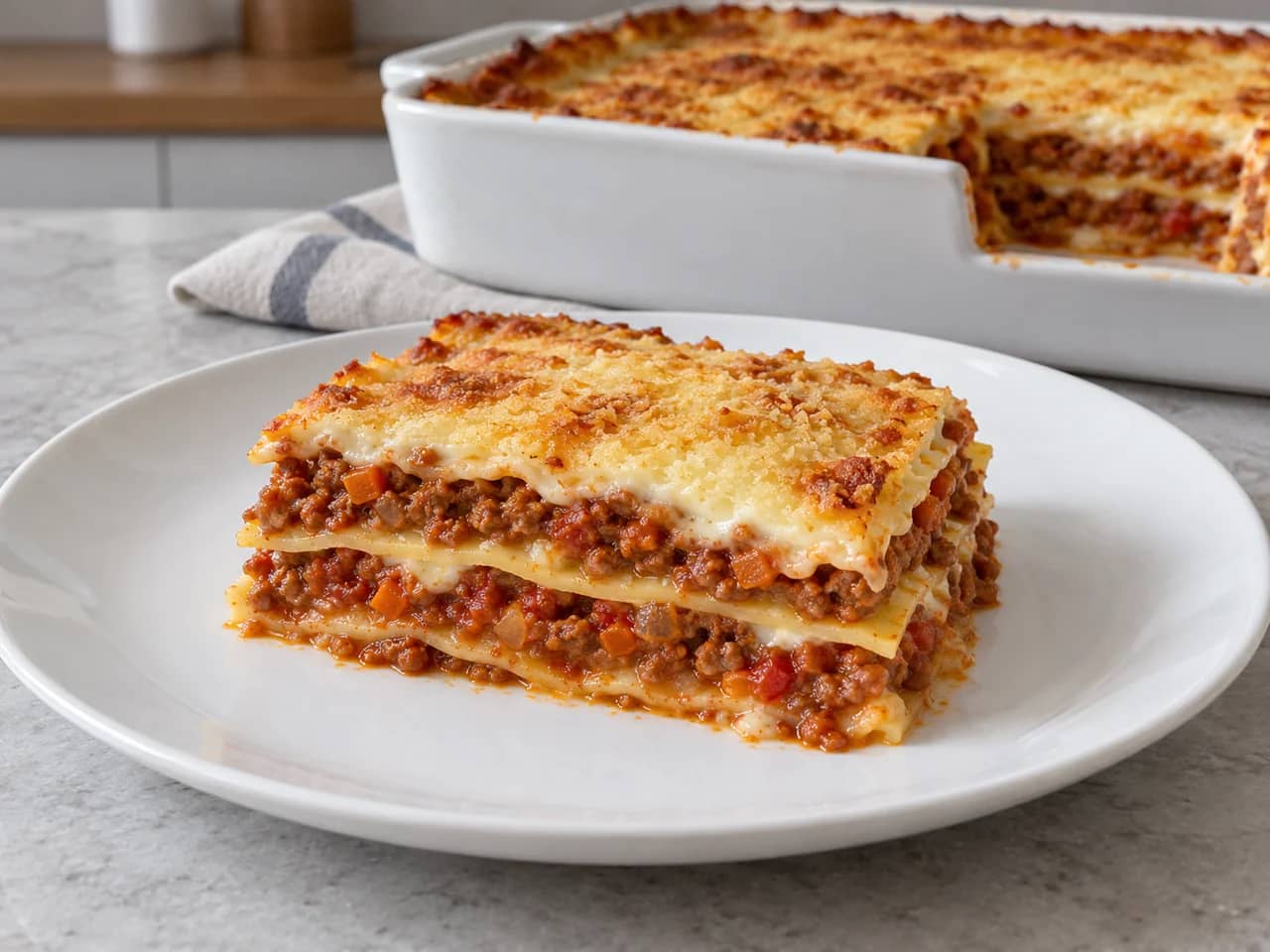
Beef lasagna with béchamel
Beef ragù, béchamel and Parmesan in three pasta layers, with quantities, assembly and checks for six portions.
- Total time
- 146 min
- Servings
- 6
- Difficulty
- Medium
- Cuisine
- Italian inspired
Ingredients
Ragù
Béchamel
Assembly
Method
Weigh the ingredients and prepare the equipment
Weigh 500 g ground beef with 10% fat and keep it refrigerated at 4 °C or below until cooking. Chop 120 g onion, 80 g carrot and 8 g garlic after washing and peeling the vegetables. Set aside 20 g oil, 800 g tomatoes with their liquid, 200 g water, 3 g salt and 1 g pepper for the ragù. For the béchamel, weigh 800 g pasteurized whole milk, 60 g unsalted butter, 60 g flour, another 3 g salt and 0.5 g nutmeg. Reserve 250 g dry sheets and 60 g grated Parmesan. Use a baking dish about 30 × 20 cm and at least 7 cm deep, a wide pan, a saucepan, scales, a whisk and a probe thermometer. Before starting, check that the sheets allow baking without preboiling at 180 °C for about 45 minutes; this schedule needs changes for pasta requiring precooking. Initial preparation is estimated at 20 minutes. Keep raw-meat utensils separate from vegetables ready to cook.
Soften the ragù vegetables
Heat the 20 g oil in the wide pan over medium heat. Add the 120 g onion and 80 g carrot and stir for about 7 minutes until softened without burning. Add the 8 g garlic and cook for 1 more minute. Allow 8 minutes for the vegetables, including the garlic. Do not add extra oil or salt at this stage.
Cook the beef without discarding its fat
Add the 500 g beef to the vegetables and increase to medium-high heat. Break up lumps with a spatula and stir for about 8 minutes, until the meat is cooked and beginning to brown. Check at least 71 °C in several places with a clean probe; colour does not replace measurement. Retain the fat and juices in the pan, as included in the estimated nutrition. Add any extra cooking time to the total. Wash hands and equipment that touched raw meat.
Simmer a moist ragù
Add the 800 g tomatoes with their liquid, 200 g water, 3 g ragù salt and 1 g pepper. Bring to a gentle simmer, partially cover and cook over low heat for about 35 minutes, stirring occasionally. The sauce should stay moist and easy to spread, with evenly distributed meat; do not reduce it to a dry paste because the sheets absorb liquid. Use all the ragù when layering. Do not add water, stock, sugar or oil without recording the change and reviewing quantities and nutrition. During the final 15 minutes of simmering, make the béchamel and preheat the oven as described below; if done afterwards, add the actual time.
Make béchamel while the ragù finishes
During the final 15 minutes of the ragù, melt the 60 g butter in the saucepan over medium-low heat. Add the 60 g flour and stir for about 3 minutes without browning it heavily. Gradually pour in the 800 g milk without heating it separately, whisking out lumps. Add the 3 g béchamel salt and 0.5 g nutmeg. Increase to medium heat and stir until gently bubbling and thickened; continue until about 7 minutes have elapsed since starting to add the milk, about 10 minutes overall for the béchamel. It should be smooth and pourable, not a stiff paste. If boiling and thickening take longer, extend cooking and add the extra time to the schedule. Use all the sauce and prevent it catching on the bottom.
Preheat and divide the components
Preheat the oven to 180 °C using conventional top and bottom heat during the same final 15 minutes of the ragù, while making béchamel on another burner. Recheck the sheet label: they must be egg-free wheat sheets suitable for baking without preboiling with a schedule compatible with 180 °C and about 45 minutes; another brand or format may need more liquid, another temperature or precooking. Divide the 250 g sheets into 3 similar parts for 3 layers, using broken pieces to fill gaps without piling them up. Divide the 60 g Parmesan into 3 portions of 20 g. Reserve 100 g cooked béchamel for the bottom and divide the rest into 3 equal portions; divide all the ragù into another 3 portions. Finished sauce weight depends on evaporation. Protect your hands when handling hot containers.
Assemble three pasta layers with their sauces
Spread the reserved 100 g béchamel over the bottom of the 30 × 20 × 7 cm dish, without extra fat. Add the first of the 3 portions of sheets and cover with one portion of ragù, one of the remaining béchamel and 20 g Parmesan. Repeat the same order with the second and third portions of sheets. Finish with ragù, béchamel and the last 20 g cheese, without a fourth pasta layer. Use all the components and cover the sheet edges thoroughly so that they do not remain dry and exposed. Leave room below the dish rim to prevent overflow. Dividing and assembling are estimated at 15 minutes, included in preparation time.
Bake and check the pasta and centre
Cover the dish with a foil tent that does not rest on the food, and bake on the middle rack at 180 °C for 30 minutes. Remove the foil with oven gloves, keeping clear of steam, then bake for about 15 more minutes: 45 minutes planned overall. Check that a knife tip enters the sheets without resistance and that the centre reaches at least 74 °C with a clean probe in several places. Browning and the photograph do not confirm those checks. If the temperature is insufficient or the pasta is firm, keep baking and add the actual time; protect the surface if already browned. Do not serve based only on the 45 minutes.
Rest before cutting
Place the hot dish on a heatproof trivet and rest for about 15 minutes before cutting; do not touch the ceramic without oven gloves. Resting helps separate the layers. The schedule totals 20 minutes initial preparation, 8 for vegetables, 8 for beef, 35 for ragù, 15 for assembly, 45 in the oven and 15 resting: an estimated 146 minutes. The 10-minute béchamel and 15-minute preheat run within the final 15 minutes of ragù cooking; if you cannot do them in parallel, add their time. Any extended cooking also changes the total.
Serve six portions and chill leftovers carefully
Divide the dish into 6 similar portions and serve with a spatula, without adding side dishes to the calculation. Put leftovers in shallow containers and refrigerate at 4 °C or below within 2 hours of leaving the oven, or 1 hour if the room exceeds 32 °C. Do not wait for the large dish to cool completely on the counter. Eat them within 24 hours. Reheat only the portions needed to at least 74 °C at the centre.
The step photos are illustrative.
Notes
Nutrition facts
One sixth of the dish; 6 servings
- Protein
- 33.6 g
- Carbohydrates
- 58.9 g
- Fat
- 27.8 g
- Saturated fat
- 13 g
- Fiber
- 4.9 g
- Sugars
- 15.3 g
- Sodium
- 881.8 mg
Nutrition information estimated from the ingredients (USDA FoodData Central). Brands may vary.
Reference source: USDA FoodData Central — SR Legacy
For general information only; it does not replace advice from a qualified health or nutrition professional.
About this recipe
Beef lasagna with a moist tomato ragù, béchamel and Parmesan, assembled in three layers of dry sheets suitable for baking without preboiling. It makes 6 servings in 146 minutes, with béchamel and preheating during the ragù simmer.
Frequently asked questions
Should I boil the sheets before assembly?
This recipe uses 250 g dry egg-free wheat sheets labelled for baking without preboiling, with instructions compatible with 180 °C and about 45 minutes. Do not boil them if their label says oven use without preboiling. If your pack requires precooking, revise water, salt, time and liquid and recalculate; do not simply insert it into these quantities.
Why is béchamel time not added separately?
The estimated 146 minutes count 20 initial preparation, 8 for vegetables, 8 for beef, 35 for ragù, 15 assembly, 45 baking and 15 resting. The 10-minute béchamel and 15-minute preheat overlap the final 15 minutes of ragù. Add actual time if you cannot work in parallel or need longer cooking.
How do I check doneness and store leftovers?
The sheets must be tender and the centre at least 74 °C with a clean probe; ground beef is first cooked to 71 °C. After the 15-minute rest, serve and refrigerate leftovers in shallow containers at 4 °C or below within 2 hours, or 1 hour above 32 °C. Plan to eat them within 24 hours and reheat to 74 °C.