
Main dishes
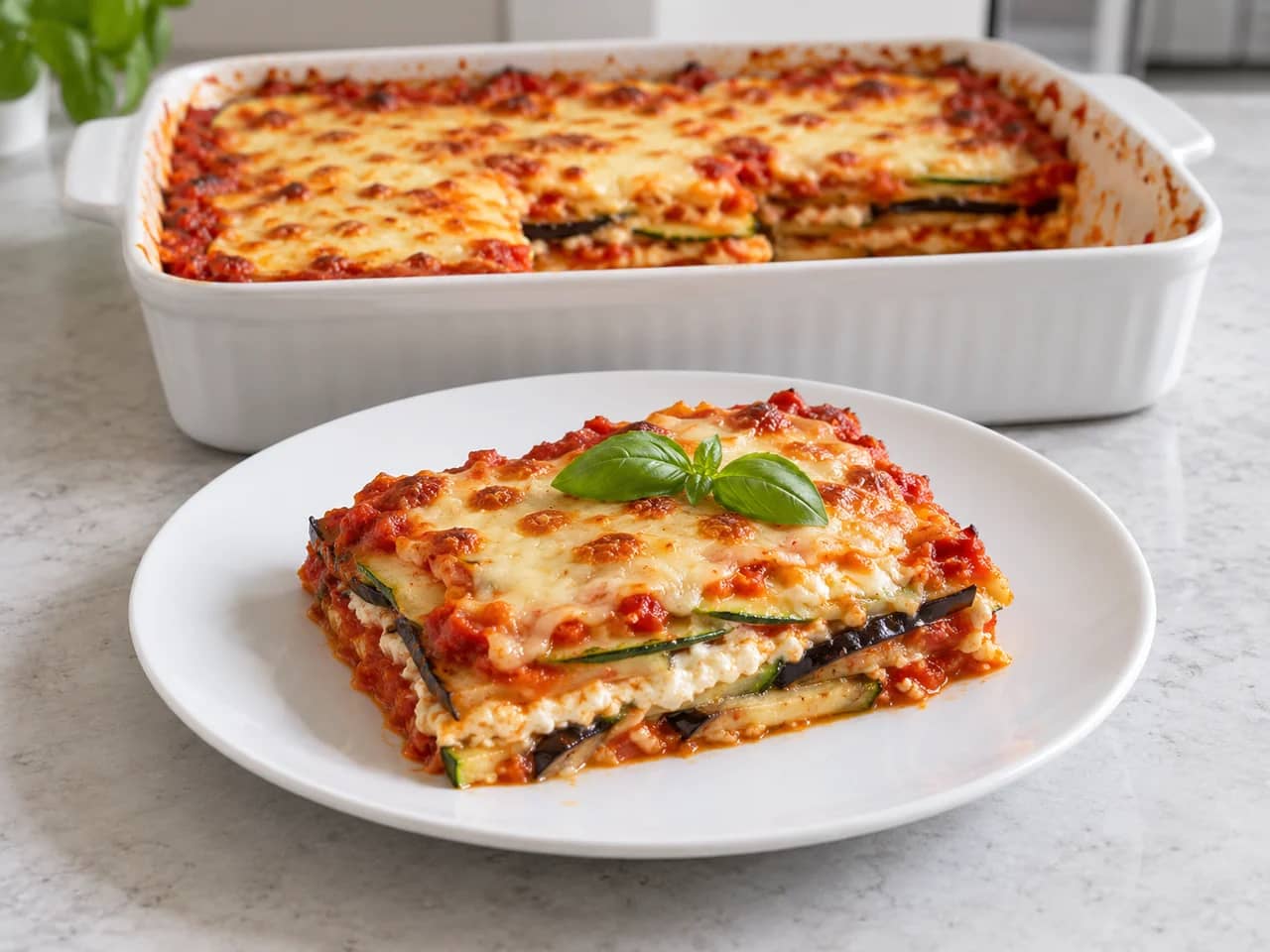
Zucchini and eggplant lasagna with ricotta
Roasted vegetable sheets, thick tomato sauce and two cheeses: six servings with each layer explained.
- Total time
- 140 min
- Servings
- 6
- Difficulty
- Medium
- Cuisine
- Italian-inspired
Ingredients
Vegetable sheets
Measured oil
Sauce
Measured salt
Cheeses
Finish
Method
Weigh the ingredients and preheat the oven
Weigh 500 g zucchini and 500 g eggplant after trimming the ends and stem, keeping the skin. Prepare 150 g chopped onion, 10 g garlic, 500 g crushed tomatoes with their liquid, 2 g oregano and 1 g pepper. Divide the 40 g oil into 20 g for vegetables and 20 g for sauce; divide the 8 g salt into 4 g for vegetables, 3 g for sauce and 1 g for ricotta. Keep 300 g ricotta and 150 g mozzarella at 4 °C or below. Wash and dry the 5 g basil. Preheat for about 20 minutes at 220 °C conventional, or 200 °C fan. Prepare two large metal baking trays, about 40 × 35 cm, and an ovenproof dish about 30 × 20 cm and at least 6 cm deep. Use vegetable sheets, without pasta sheets.
Slice and brush the vegetables
Cut zucchini and eggplant lengthwise into sheets about 5 mm thick using a knife and a stable board. Arrange each vegetable on its own tray in a single layer, without piling up the sheets. Brush both sides of the zucchini with 10 g oil in total and season with 2 g salt; use the other 10 g vegetable oil and 2 g salt for the eggplant. Do not grease the trays separately or add oil beyond the measured 40 g. If everything will not fit without overlapping, prepare an additional batch and add its actual time; do not hide a second batch within the planned oven time.
Roast the vegetables and lower the oven temperature
Bake both trays for about 25 minutes at 220 °C conventional, or 200 °C fan. Halfway through, swap shelf positions and rotate the trays if they brown unevenly; start checking at 20 minutes. The sheets should be flexible and lightly golden, with no hard patches or puddle of water on the tray. Continue if necessary and add the extra time to the total. Remove with oven mitts and keep all the sheets for assembly. Lower the already hot oven to 200 °C conventional, or 180 °C fan, for the final bake.
Cook a thick tomato sauce
Heat the 20 g oil reserved for sauce in a wide pan over medium heat. Cook the 150 g onion for about 5 minutes, stirring until softened without burning. Add the 10 g garlic and stir for 1 minute. Add the 500 g tomatoes with their liquid, 3 g salt, 2 g oregano and 1 g pepper. Simmer uncovered over low heat for about 14 minutes, stirring, until a spoon leaves a brief track and no watery rim separates. This schedule allows 20 minutes for cooking the sauce. If it remains runny, reduce it a few minutes longer and add the time to the total; do not add flour, sugar, stock or oil without recalculating the recipe.
Prepare the ricotta and divide the components
Mix the 300 g ricotta with the reserved 1 g salt, without egg or cream and without draining an amount already included in the nutrition calculation. Divide this 301 g mixture into two equal parts of 150.5 g: each contains 150 g ricotta and 0.5 g salt. Divide all the cooked sauce into four equal parts; its final weight depends on evaporation. Divide all the roasted vegetables into three similar parts, with zucchini and eggplant in each. Reserve the 150 g mozzarella for the surface. Use clean spoons and assemble once the components can be handled without burns.
Spread the sauce base and first vegetable layer
Put one of the four parts of sauce in the bottom of the 30 × 20 cm dish, without additional oil. Spread one of the three parts of vegetables over it, alternating zucchini and eggplant to cover the base. Slight overlapping is fine during assembly, without a mound in the center; the sheets have already been roasted separately. Use short pieces to fill gaps without discarding vegetables included in the quantities. Do not add pasta sheets to this version.
Add the first ricotta layer and second vegetable layer
Spread one 150.5 g part of seasoned ricotta over the first vegetable layer in small spoonfuls, then smooth it gently. Add the second of the four parts of sauce and arrange the second of the three parts of vegetables, mixing zucchini and eggplant. Keep the layers level right to the edges. Reserve the other half of ricotta, two parts of sauce, the last part of vegetables and all the mozzarella for the next step, so every layer receives its planned amount.
Finish the layers and add the mozzarella
Spread the remaining 150.5 g seasoned ricotta over the second vegetable layer, followed by the third part of sauce. Add the last part of vegetables and cover with the fourth and final part of sauce. Spread the 150 g grated mozzarella over the entire surface. Assembly uses three vegetable layers, two ricotta layers and four portions of sauce, including the bottom. Do not add extra cheese, Parmesan, egg, meat or béchamel. Reserve the basil until after baking.
Bake until the center is thoroughly hot
Tent the dish with foil without letting it touch the tomato or cheese. Bake at 200 °C conventional, or 180 °C fan, for about 20 minutes. Remove the foil using oven mitts and bake for another 15 minutes, 35 in total; start checking at 30. Look for melted, lightly golden mozzarella, bubbling sauce and tender vegetables. Use a clean probe to check that the center reaches at least 74 °C; a photograph does not confirm a measured temperature. If the center is too cool or much free water remains, continue for a few minutes and add the time to the total, shielding the surface if it browns too much. Use oven mitts and set the hot dish on a heatproof surface.
Rest and serve six portions
Rest the dish for about 10 minutes on a trivet before cutting. Vegetable lasagna may form a softer portion than pasta lasagna. Divide into 6 similar portions and distribute the 5 g clean basil when serving. The conservative schedule totals 30 minutes preparation, 80 cooking (25 roasting, 20 sauce and 35 final baking) and 30 waiting (20 preheating and 10 resting): an estimated 140 minutes. No overlapping tasks are deducted. Add the actual time of extra vegetable batches, sauce reduction or baking.
The step photos are illustrative.
Notes
Nutrition facts
One sixth of the dish; 6 servings
- Protein
- 12.8 g
- Carbohydrates
- 21.1 g
- Fat
- 18.6 g
- Saturated fat
- 8.2 g
- Fiber
- 5.6 g
- Sugars
- 10.2 g
- Sodium
- 914.7 mg
Nutrition information estimated from the ingredients (USDA FoodData Central). Brands may vary.
Reference source: USDA FoodData Central — SR Legacy (abril de 2018)
For general information only; it does not replace advice from a qualified health or nutrition professional.
About this recipe
A lasagna made with roasted zucchini and eggplant sheets, tomato sauce, ricotta and mozzarella. Vegetables form the layers in this version; there are no pasta sheets. The yield is 6 servings. The estimated 140 minutes include roasting, sauce, final baking, preheating and resting.
Frequently asked questions
How do I stop the lasagna becoming watery?
Roast the roughly 5 mm sheets in a single layer and cook the sauce until no watery rim separates. Do not pile raw vegetables into the dish. The 25 minutes roasting and 14 minutes tomato reduction are estimates; continue if necessary and add the actual extra time.
Can I add pasta sheets?
This version uses three roasted vegetable layers, two ricotta layers and four portions of sauce. Adding pasta changes the required liquid, assembly, timing, yield and nutrition. Use an adapted recipe and recalculate rather than inserting dry sheets into these same quantities.
Can I assemble it the day before?
You can prepare the components and assemble it for the next day if you cool and refrigerate them correctly at 4 °C or below in suitable containers within 2 hours, or 1 hour above 32 °C. A cold dish needs longer in the oven than stated; check at least 74 °C in the center and count the actual time. The same 35-minute bake is not promised.